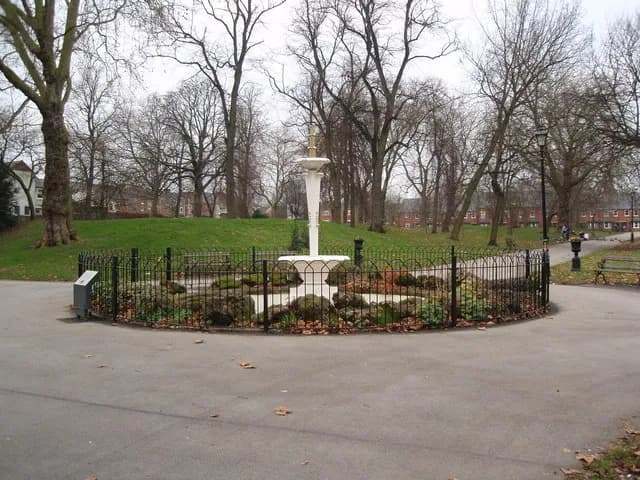
On 16 September 1840, a textile magnate opened an eleven-acre garden on the southern edge of Derby and invited the world inside. The opening drew roughly 25,000 people and established an idea that would reshape cities across the globe: that ordinary citizens, not only the landed gentry, had a right to cultivated green space.
Joseph Strutt's Radical Gift
The park was the gift of Joseph Strutt, a local textile manufacturer, philanthropist and former Mayor of Derby. Strutt funded the design and construction personally at a cost of £10,000, drawn from a family fortune built on the labour of Derby's working people. He declared that it would be "ungrateful in me not to employ a portion of the fortune which I possess, in promoting the welfare of those amongst whom I live, and by whose industry I have been aided in its acquisition". That sentiment reflected a broader social reform impulse; Strutt believed the working classes deserved access to the same civilised pleasures, including open spaces and art, that the upper classes took for granted.
Loudon's Gardenesque Vision
Strutt commissioned the Scottish botanist and landscape gardener John Claudius Loudon to design the grounds. Work began in July 1839, and Loudon set about creating what he termed an "arboretum": a scientifically arranged collection of trees and shrubs intended for public instruction as well as leisure. The original park contained more than 1,000 species, each labelled and catalogued, with Strutt stipulating that no species should be repeated so that visitors would be encouraged to walk the entire circuit. Loudon employed raised banks planted with trees and shrubs to disguise the park's boundaries, giving the illusion of far greater space than the original eleven acres.
What Made It Public
Derby Arboretum is widely recognised as the first park to be specifically designed for and owned by the public in England. Earlier green spaces had existed, including common land and private estates, but none had been deliberately planned as a place of public recreation within an industrial town. Access came with conditions: adults paid sixpence and children threepence on most days, although admission was free on Sundays and Wednesdays, the days when local workers were most likely to have time away from the factories. The charges were not finally abolished until 1882.
From Derby to Central Park
The influence of Derby Arboretum extended far beyond the Rose Hill neighbourhood. In 1859 the American landscape architect Frederick Law Olmsted visited the park during a European research tour; he later incorporated features of Loudon's design into his plan for Central Park in New York. Professor Paul Elliott of the University of Derby has noted that the Arboretum holds "an important place in the history of landscape gardening" and became a model for many subsequent parks. Loudon himself had already shaped other notable landscapes, including the Birmingham Botanical Gardens, and his writings on urban green space helped lay the groundwork for the Victorian public parks movement.
War, Decline and Renewal
The Arboretum suffered significant damage during the Second World War. A German air raid on 15 January 1941 destroyed the Victorian bandstand, while the Florentine Boar statue, an earthenware copy by William John Coffee dating from 1806, lost its head in 1940 and was later further damaged. The boar was eventually replaced by a bronze replica created by Alex Paxton, unveiled on 18 November 2005. The park itself was listed at Grade II* on the Historic England Register of Parks and Gardens in 1984, and in the early twenty-first century it received several million pounds from the Heritage Lottery Fund for a comprehensive restoration.
The Arboretum Today
Today Derby Arboretum sits approximately one mile south of the city centre at Arboretum Square, bounded by entrances on Reginald Street and Arboretum Square off Osmaston Road. It is owned and managed by Derby City Council, and its facilities now include the Heart of the Park community building with a café, modern playgrounds, sports pitches, and two bowling greens used by local clubs. The park remains open daily throughout the year, and volunteer groups continue to support its upkeep. For many Derby residents, the Arboretum remains what it was always intended to be: a place of recreation, instruction, and escape from city life.