On 9 August 1939, Gordon Richards rode one of the last winners ever seen at Derby. Within weeks the country was at war, the course off Nottingham Road was taken over by the Royal Artillery, and anti-aircraft guns stood where the horses had galloped. When peace came, the town council decided that racing would not return, on the grounds that it would "bring the wrong sort of people into the town". The grandstand survived for decades before it was demolished in 2001, and the land became the playing fields that Derby still calls Racecourse Park.
So when Derby goes racing now, it goes west to Uttoxeter or east to Nottingham. Both are a direct train ride from Derby station, and between them they offer six meetings this October, three over jumps and three on the flat.
The October 2026 fixtures
Uttoxeter (jumps)
- Sunday 4 October: Sunday afternoon jump racing.
- Friday 16 October: Gents Day.
- Friday 30 October: the course's raceday for residents of its own ST14 postcode.
Nottingham (flat)
- Wednesday 7 October: an afternoon meeting.
- Wednesday 14 October: Construction Day, featuring the Colwick Cup, Nottingham's premier long-distance handicap over two miles, newly moved from August to October.
- Wednesday 28 October: Community Raceday.
The racecourse Derby lost
Racing in Derby goes back a long way. It is mentioned in a play of 1639, and by the early eighteenth century meetings had settled on Sinfin Moor, where a prefabricated grandstand went up in 1748. The moor was prone to waterlogging, so racing sometimes moved to the Holmes beside the Derwent, until the railways made that site impractical. The last meeting there was in 1844.
The final Derby racecourse opened in May 1848 on land off Nottingham Road, between Little Chester and Chaddesden. It had a straight mile, a grandstand designed by the architect Henry Duesbury and put up in 1852, and from 1856 its own station on the Midland Railway, Nottingham Road, opened to bring racegoers to the gate. The ground became a sporting hub. South Derbyshire Cricket Club moved there in 1863, and the cricket ground built inside the southern curve of the track became the County Ground once Derbyshire began playing there in 1871. Derby County played their football at the racecourse from 1884 to 1895, and the ground staged an FA Cup Final replay and an England international.
Archaeologists digging on the site have since found a Roman settlement underneath it, which makes the racecourse only the latest chapter in a very old story.
Why the Derby is not named after Derby
It is the question every Derby racegoer is asked sooner or later. The Derby at Epsom, first run on 4 May 1780, takes its name from Edward Smith-Stanley, the 12th Earl of Derby. The race was planned at a celebration after the first running of the Oaks in 1779, and the honour of naming it lay between the Earl, who was the host, and his guest Sir Charles Bunbury. Legend says a coin was tossed. The more likely explanation is that Bunbury, a steward of the Jockey Club, deferred to his host. Bunbury had the consolation of owning the first winner, Diomed.
The earldom itself has little to do with Derby either. The Stanley family were made Earls of Derby in 1485, after supporting Henry VII at Bosworth, and their seat is Knowsley in Lancashire. The title is generally traced to West Derby, the old administrative hundred around Knowsley and Liverpool, rather than to Derbyshire. Every "derby" since, from Kentucky to the local football derby, borrows the Earl's name, not the city's.
For the seasoned racegoer
The two courses could hardly be more different, which is part of the appeal of having both on the doorstep.
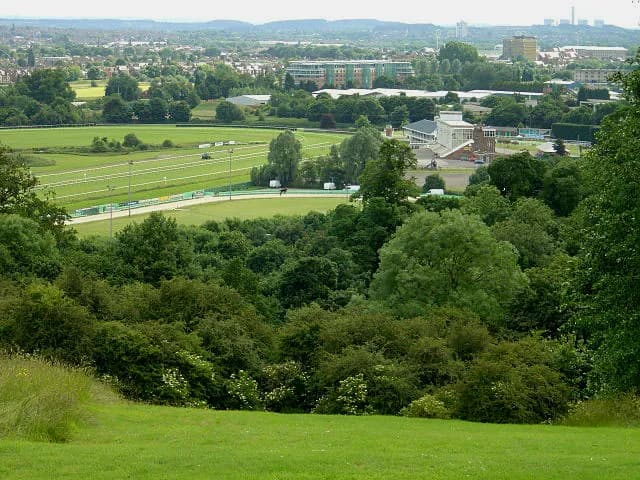
Uttoxeter is a left-handed jumps oval of about a mile and two and a half furlongs. Its back straight has a right-handed dog-leg and climbs over Clump Hill before running down to the home turn, and the four-furlong home straight is flat and galloping. October there is early-season fare: novice hurdles, handicap chases, and horses having their first run since the spring. The course's big days, the Midlands Grand National and the Summer Cup, are in March and summer, but the Midlands National gives the place its finest story. In 1997 Lord Gyllene, owned by Uttoxeter's then chairman Sir Stanley Clarke, was second in it and went on to win the Grand National at Aintree by 25 lengths.
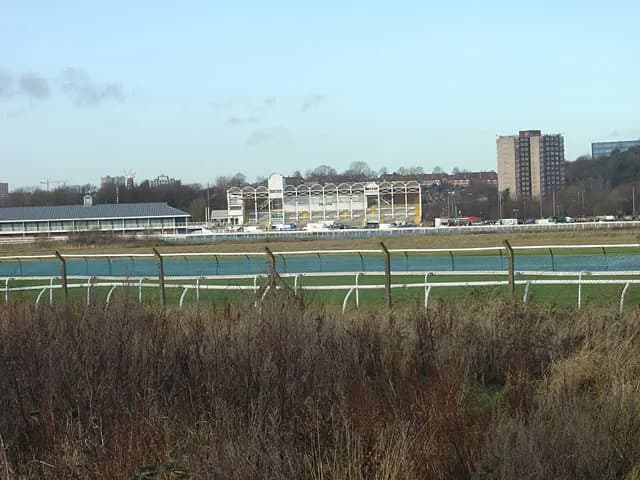
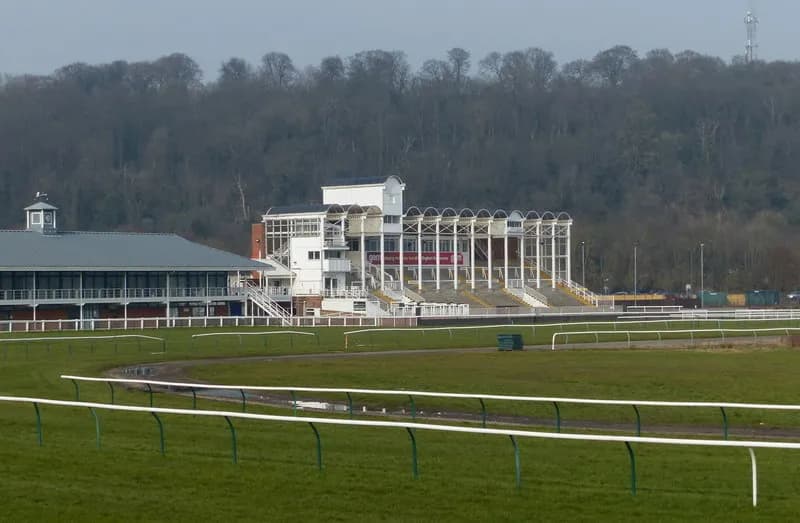
Nottingham, at Colwick Park beside the Trent, has been flat-only since it gave up jump racing in February 1996. It has two left-handed courses of about a mile and a half each, with a five-furlong straight on the inner and six furlongs on the outer. The turns are generally easy and the gradients slight, though the home turn is fairly sharp. October flat cards at a course like this are a mix of maidens and novice races for juveniles, which can throw up a future pattern horse, and handicaps for exposed older horses at the end of a long season. The Colwick Cup's move to mid-October adds a proper stamina test, and late-season ground can make two miles feel a good deal further.
For a first visit
A weekday at Nottingham or a Sunday at Uttoxeter is a gentle introduction. Neither course is large, so you can see the parade ring, the betting ring and the finish without walking far. Buy a racecard: it lists every runner, jockey, trainer and the weight each horse carries.
In the parade ring, look at how a horse moves and behaves. A relaxed, alert horse with a good coat is usually a better sign than one that is sweating heavily or fighting its handler. At a jump meeting, watch the first fence of each race too: confident, accurate jumping is half the battle.
The Tote pools all stakes and shares them among the winning tickets, so you only know the return after the race. Bookmakers offer fixed odds that you lock in when you bet. An each-way bet splits your stake between win and place, so it pays something if your horse finishes in the places. Set a budget before the first race and keep to it.
Dress is relaxed at both courses: smart-casual works everywhere, and the October weather matters more than any rule. Bring a coat.
Making a day of it
For Uttoxeter, take the train from Derby along the Crewe line through Tutbury and Hatton. Uttoxeter station is right beside the racecourse on Wood Lane, and the A50 links the two towns directly by road. Allow time for the old market town itself: the Market Place holds the small Johnson Memorial, which recalls Samuel Johnson standing bareheaded in the rain as penance for refusing, as a boy, to help at his father's bookstall there.
For Nottingham, trains from Derby run straight into Nottingham station, about two miles from the course. Taxis wait at the station, buses run out towards Colwick from the city centre, and Netherfield station is a walk of under a mile. Colwick Country Park lies right beside the racecourse, with lakes and riverside paths for a stroll before racing. In the city, Nottingham Castle on its sandstone rock, the Old Market Square and the old warehouses of the Lace Market are all within walking distance of one another. Nottingham's own racing roots are in the city too: for around two centuries meetings were held on the Forest, until racing moved to Colwick in 1892.
And for a Derby postscript, walk the edge of Racecourse Park and the County Ground on a quiet morning. There is not much to see of the old course now, which is rather the point.
Before you go
Check each racecourse's website for first-race times, tickets and enclosures, and look again for the going and any inspection on the morning. Autumn weather can cost a meeting at short notice, at Colwick and at Uttoxeter alike.