Joseph Wright was born in Irongate, Derby, on 3 September 1734, and he died in the same city sixty-two years later. Throughout his life, the painter remained anchored to Derby, and the city shaped the art that would earn him international recognition as the foremost visual chronicler of the Enlightenment.
From Derby to London and Back
Wright was the third of five children born to John Wright, an attorney who served as town clerk of Derby, and Hannah Brookes. His father's position placed the family at the centre of Derby's civic and professional life. In 1751, at the age of seventeen, Wright left Derby to study under Thomas Hudson in London. Hudson was the pre-eminent portrait painter of the day and had trained Joshua Reynolds. Wright spent two years with Hudson, then returned as his assistant for a further fifteen months before establishing himself as a portrait painter in Derby.
Between 1768 and 1771, Wright worked in Liverpool, building a reputation and clientele. He later attempted to establish himself in Bath, the fashionable spa town that had proved lucrative for Reynolds and Thomas Gainsborough. The experiment failed; Wright returned to Derby in 1777 and remained there until his death on 29 August 1797 at No. 28 Queen Street.
The Painter of Light
Wright's artistic signature was his mastery of chiaroscuro, the dramatic contrast of light and shadow. Critics compared his technique to that of Caravaggio, but Wright applied it to distinctly eighteenth-century subjects. He became known as the "painter of light" for his candlelit scenes, which illuminated not merely faces and objects but the intellectual ferment of the age.
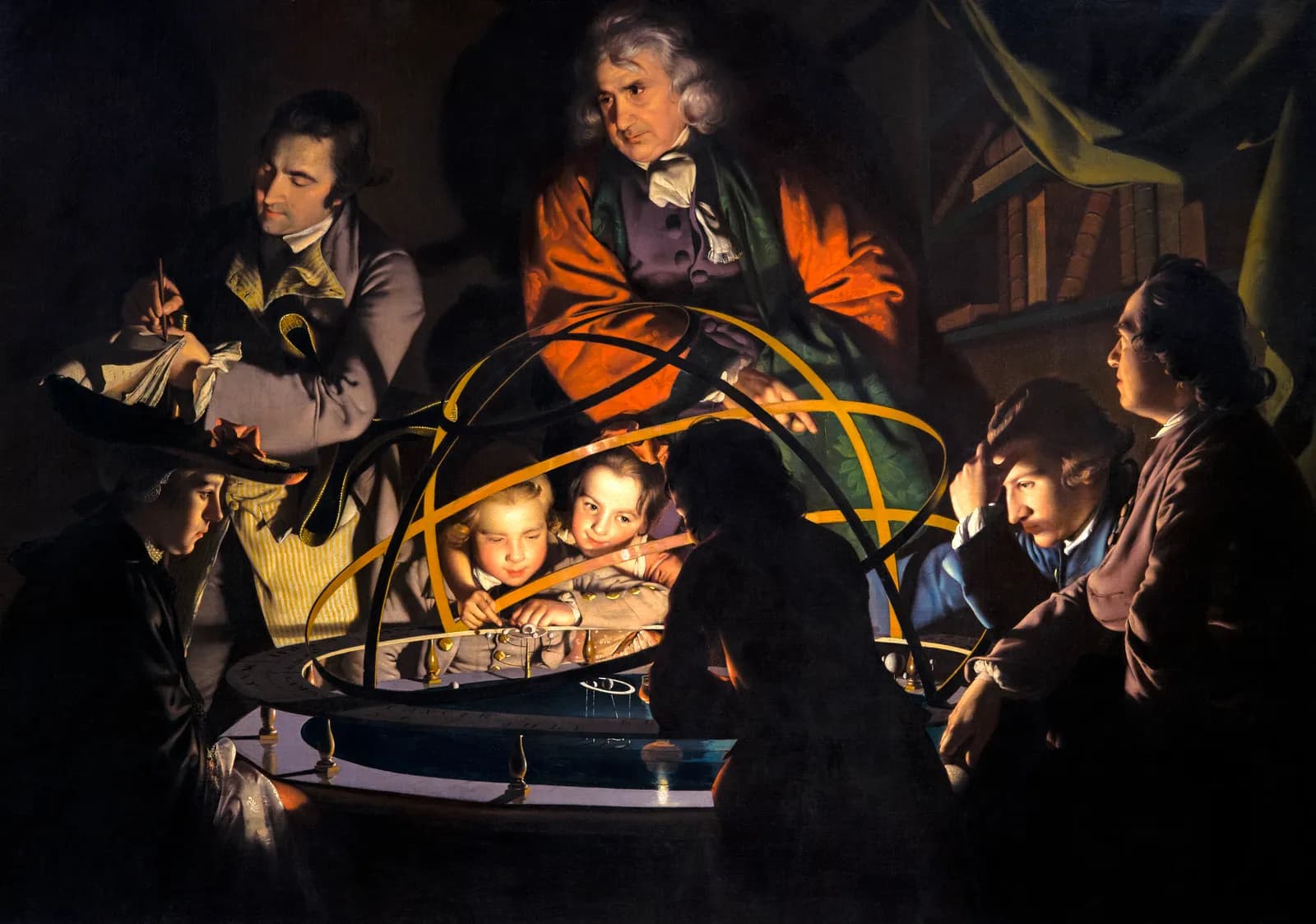
His breakthrough came with Three Persons Viewing the Gladiator by Candlelight (1765), but it was the paintings that followed which secured his place in art history. A Philosopher Lecturing on the Orrery (1766) depicts a mechanical model of the solar system, with a lamp substituting for the sun, casting dramatic light across the faces of the audience. The painting is now held by Derby Museum and Art Gallery. An Experiment on a Bird in the Air Pump (1768), in the collection of the National Gallery in London, shows a scientific demonstration of vacuum, with spectators reacting with varying degrees of fascination and distress as a cockatoo suffocates in the glass chamber.
These works captured something unprecedented: the drama of scientific discovery. At a time when the Royal Society was transforming natural philosophy into modern science, Wright made the laboratory as worthy of artistic attention as the salon or the battlefield. The art historian F. D. Klingender described him as "the first professional painter to express the spirit of the Industrial Revolution."
Derby's Scientific Circle
Wright's preoccupation with science and industry reflected his Derby milieu. The city in the mid-eighteenth century was a hub of intellectual and industrial activity. Wright counted among his friends and patrons some of the most significant figures of the age.
Erasmus Darwin, the physician, poet, and grandfather of Charles Darwin, lived in Derby and moved in Wright's circle. John Whitehurst, the clockmaker and scientist, was a neighbour. Among Wright's patrons were Josiah Wedgwood, the potter whose factory at Etruria was revolutionising ceramic manufacture, and Richard Arkwright, the inventor of the water frame and father of the factory system. Though Wright was not a formal member of the Lunar Society of Birmingham, he moved in its orbit and painted its members.
Derby itself provided the subject matter for his art. The city's Town Hall hosted regular lectures and scientific demonstrations, which Wright attended. In July 1762, he went to lectures by James Ferguson, a Scottish astronomer whose orrery demonstrations likely inspired Wright's famous painting.
Italy and the Sublime
Between 1773 and 1775, Wright travelled to Italy with his wife Ann Swift, whom he had married in 1773, along with fellow artist John Downman and Richard Hurleston. The journey took him to Naples, where he witnessed Mount Vesuvius erupting. The volcano became a recurring subject in his later work, including Vesuvius from Posillipo by Moonlight (1774). The experience of Italian light and landscape influenced his subsequent paintings, though he never abandoned the dramatic chiaroscuro that defined his early work.
Recognition and Character
Wright's talent was recognised by his peers. He was elected an Associate of the Royal Academy in 1781 and a full member in 1784, though he declined the latter honour. A critic of the period dubbed him "Joseph Wright of Derby" to distinguish him from another artist named Wright; the epithet stuck and became a badge of local pride.
Contemporary accounts suggest a man of contradictions. Lucy Salt, keeper of fine art at Derby Museums, has noted that "there's a really wild streak in Wright. He was very intelligent... but he was obviously quite a difficult man, nervous, ill, anxious." This nervous temperament did not prevent him from producing works of startling power and ambition. Stuart Gillis, head of museum transformation at Derby Museums, observed: "He's not an easy sell. This isn't just easy sugary stuff. There's real worth here."
Legacy in Derby Today
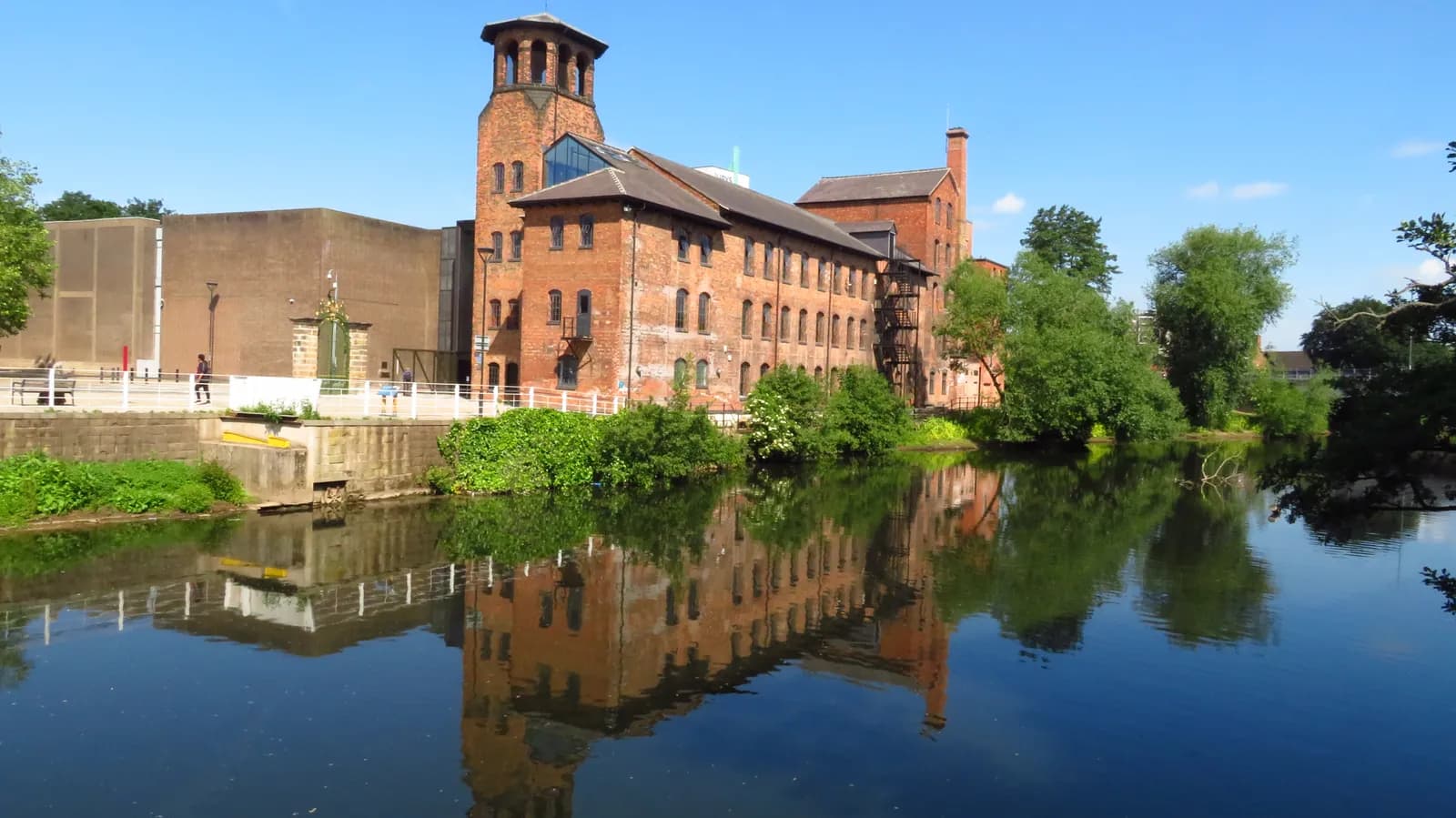
Wright's connection to Derby continues to be celebrated and preserved. The Derby Museum and Art Gallery houses the world's largest collection of his works, including the Joseph Wright Gallery dedicated to his paintings and the Joseph Wright Study Room containing over three hundred drawings, sketches, engravings, and letters. The museum's collection includes The Alchemist Discovering Phosphorus (1771) and the Orrery, along with recent acquisitions such as a self-portrait from around 1780.
The city has marked his memory in stone and metal. An armillary sphere memorial stands at Irongate, his birthplace. A blue plaque at 27 Queen Street, announced in 2013, marks another of his Derby residences. His tombstone, originally at St Alkmund's Church, was moved to Nottingham Road Cemetery and later mounted on the wall of Derby Cathedral in 2002.
Education carries his name forward. The Joseph Wright Centre, Derby College's flagship site on Cathedral Row, opened in 2005. The college cites Wright's "capturing of the scientific and technological advances of the 18th century" as the inspiration for the name, reflecting his enduring association with intellectual progress.
Wright of Derby: From the Shadows
In 2026, Derby Museum and Art Gallery will host "Wright of Derby: From the Shadows," a major exhibition running from 13 June to 1 November. Organised in collaboration with the National Gallery, the exhibition promises to reinterpret Wright not merely as a "painter of light" but as an artist who explored deeper themes of knowledge, mortality, and the human condition.
The exhibition represents more than a retrospective; it is an assertion of Derby's place in the story of British art. Joseph Wright of Derby was a provincial painter who became, through talent and timing, the visual chronicler of an age. His work remains in the city where he was born, available to the public in the museum that bears his legacy. For Derby, he is not merely a famous son but a permanent resident, his light still illuminating the city he never truly left.